

Principles and methods of softening hard water that you should know
1. Principle of softening hard water
The most common principle
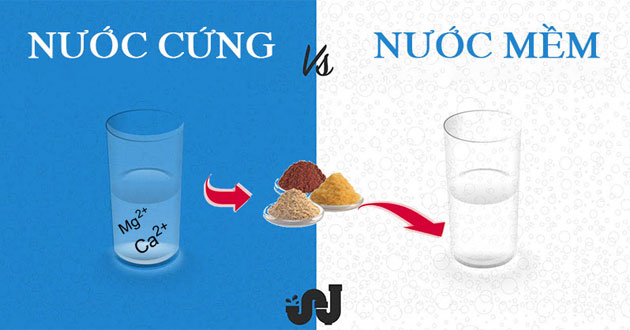
| The principle of softening hard water is to reduce the content of Ca2+ and Mg2+ ions in hard water to the allowable level of 0 - 60 milligrams/liter. According to this principle, people often apply the precipitation method, which means adding some chemicals into the water that can react with free cations to form insoluble precipitates in water or using the ion exchange method - replacing them with other ions. |
In addition, with the development of technology, there are now many other hard water treatment methods besides precipitation and ion exchange such as:
- Reverse osmosis method: Using a filtration system to remove all impurities from the water source, providing almost pure water, free of dirt, dissolved solids or cations Ca2+, Mg2+.
- Dissolution or chemical method: This method of softening hard water is commonly used in industries. Different chemicals such as Na2CO3, Ca(OH)2, Na3PO4, M(HCO3)2 MCO3, will be dissolved in water to react chemically with Ca2+, Mg2+ ions, thereby forming water-soluble compounds or forming precipitates to effectively reduce hardness.
2. Methods of softening hard water
Nowadays, people often treat hard water by one of the following methods:
2.1. Softening hard water by boiling (thermal distillation)
Boiling is the simplest method of softening hard water, often applied to temporary hard water. Under the effect of high temperature, bicarbonate salt (HCO3-) will decompose to form a precipitate separate from the water source. The resulting water is soft water with low hardness.
Price: No investment costs.
Advantage
- Simple to do.
- No initial investment costs and preparation tools.
Disadvantages
- The quality of the water obtained is not high.
- Difficulty in dealing with large amounts of hard water.
- Only treats temporary hard water, not effective with the other two types of hard water.
2.2. Hard water treatment with total filter
The general filter usually applies the ion exchange principle, when the hard water source passes through this system, Ca2+ and Mg2+ ions will be retained in the device and replaced by other ions such as Na+ and K+ in the ion exchange resin or Cation beads. This is a method widely used in industry or in water filtration products.
Price range: From 2,000,000 - 50,000,000 VND.
Advantages: Short processing time, long service life.
Disadvantages: High investment and operating costs for equipment.
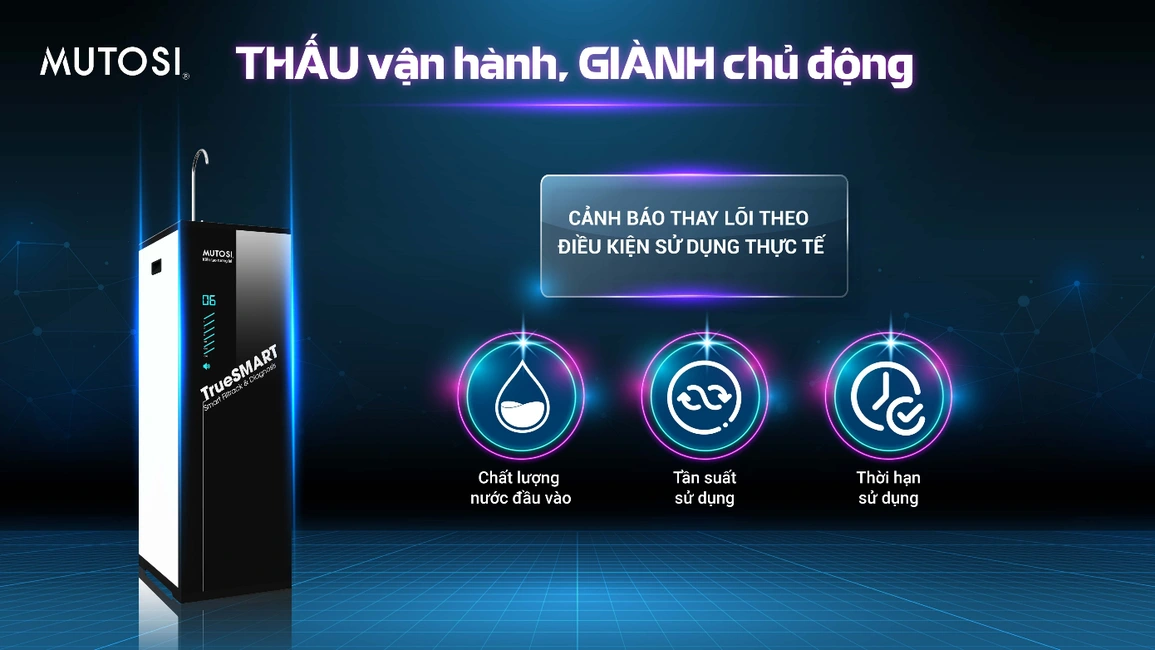
If you want to choose a quality total filter to treat hard water at home, please refer to the product line from Mutosi. This device possesses modern filtration technology that helps remove many impurities, dirt and metal ions in the initial water source. Thereby effectively treating hard water sources (water contaminated with limestone), providing users with an effective solution to protect their health.
Refer to the quality total filtration system here: TOP 07 Most Trusted Source Water Filter Systems
2.3. Treating hard water with RO water purifier
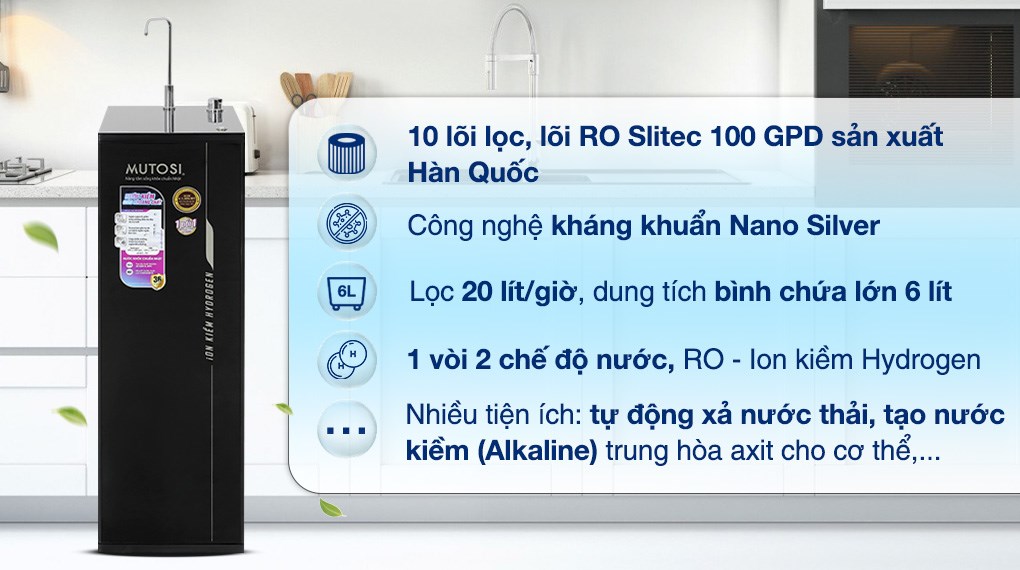
Machine RO water filter is a modern device that can effectively handle hard water in the home. This product has a rough filter system and RO membrane that uses reverse osmosis method to filter out all dirt, impurities, bacteria and metal ions from the water source. Thanks to that, the output water is almost pure and at the same time effectively reduces hardness.
Price range: From 5,000,000 - 15,000,000 VND.
Advantage
- Thoroughly treat hard water.
- The quality of the water obtained is high and can be used directly.
Disadvantages
- High initial investment cost.
- Periodically need to replace new filter core.
With the above sharing, it can be seen that using a water purifier is the most effective method of softening hard water. With many outstanding advantages, Mutosi water purifier is a great choice for many families today.
This device has a modern RO filter membrane that meets international NFS standards with ultra-small filter holes of only 0.001 micrometers. Therefore, it provides specialized treatment of hard water sources, the output water meets the Ministry of Health's direct drinking water standards when all harmful mineral ions in the water are removed. Mutosi filter will provide users with an effective solution to protect the health of themselves and their families.
2.4. Treating hard water with lime
In addition to the above methods, we can also reduce the hardness of water by adding slaked lime or Ca(OH)2. When this substance is added to water, a chemical reaction will occur to form a precipitate. Filtering out this precipitate, we will obtain soft water with low mineral content.
Price: 10,000 - 20,000 VND.
Advantage
- Reasonable cost.
- Easy to do.
Disadvantages
- The water obtained is not suitable for drinking.
Above are the principles and methods of softening hard water that are widely applied today. Hopefully, through the above sharing, you will find the most effective and suitable solution for your family's water source. If you have any questions, do not hesitate to contact Mutosi via hotline 1900 636 595 for advice and detailed information.
Related Posts