

Learn about hard water: Concept, classification & how to soften water
1. Concept of hard water
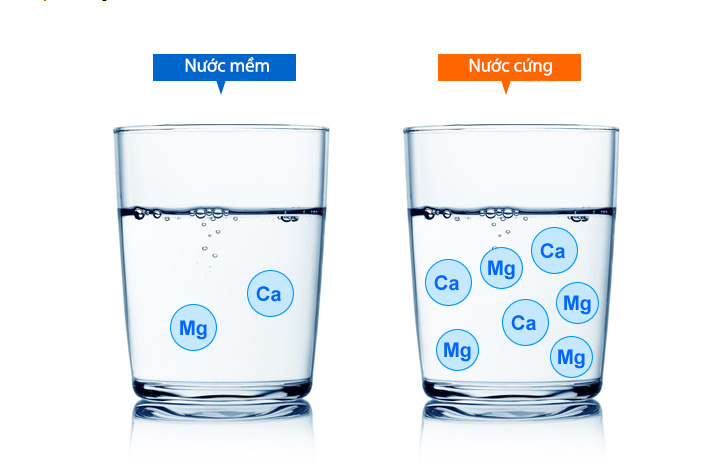
Hard water is a water source that contains a large amount of mineral ions with concentrations exceeding the permissible level, usually above 300 mg/liter. The main components of hard water are metal ions such as Ca2+ and Mg2+. In addition, some water sources also contain other cations such as ions of iron, strontium, aluminum, barium, manganese, zinc, etc.
Meanwhile, normal water or soft water contains very little of these minerals and usually has a cation concentration of <60 mg/L.
Cause of formation:
Hard water is often formed through the natural flow of water. Groundwater tends to travel through many terrains, which also allows it to absorb many nutrients in the soil, including trace elements such as calcium and magnesium.
In particular, in areas with mineral mines or limestone mountains, the water source here will have a high risk of dissolving a large amount of Ca2+ and Mg2+ ions. When the concentration of these two ions exceeds the allowable threshold >300mg/liter, this water source will be called hard water or limestone-contaminated water.
Discover the detailed causes of hard water here: 3+ Top Causes of Hard Water
2. Signs of hard water
You can identify whether your home water source is hard water or not by some of the following signs:
- After long-term use, rust and scale will appear on the faucet or shower, causing the water flow to become blocked.
- White residue forms on the bottom of cooking appliances such as pots, pans and kettles.
- Less foaming with soap, dishwashing liquid,... After washing, clothes still contain a lot of detergent residue, after a while they will gradually dry out, fade and quickly deteriorate.
- A thin layer of scum appears if hard water is used to make drinks.
- Ice made from hard water is cloudy and dissolves faster than regular ice.
| Hard water is a common phenomenon in Vietnam, especially in localities with limestone mountains such as Ha Giang, Cao Bang, Lang Son, Quang Ninh, Lai Chau, Lao Cai, Son La, Hoa Binh, Ninh Binh, etc. |
3. Types of hard water
In nature, hard water sources can be classified in one of two ways:
3.1. Based on the ion content of Ca2+, Mg2+3
According to the United States Geological Survey (USGS), water hardness is determined based on the concentration of calcium (Ca2+) and magnesium (Mg2+) metal cations or TDS index and is divided into the following basic types:
| Water type | TDS |
| Soft water | 0 - 60 mg/L |
| Moderately hard water | 61 - 120 mg/L |
| Hard water | 121 - 180 mg/L |
| Very hard water | >= 181 mg/L |
3.2. Based on salt content in water
Based on the characteristics of the salts in hard water, we can divide it into 3 types as shown in the following table:
| Evaluation criteria | Temporary hard water | Permanent hard water | Total hardness |
| Wall part | Consists of 2 salts Ca(HCO3)2 and Mg(HCO3)2 | Salts MgCl2, CaCl2, MgSO4 and CaSO4 | Salts MgCl2, CaCl2, Ca(HCO3)2, Mg(HCO3)2, MgSO4, CaSO4 |
| Water characteristics | Contains temporary hardness, salts in water are easily decomposed at high temperatures | Contains permanent hardness, salt in water is stable at high temperatures | Includes both temporary and permanent hardness, containing both easily decomposed salts and those that are resistant to high temperatures. |
| Softening ability | Boil water | Using chemicals or ion exchange methods | Use a combination of methods or use a water filter. |
Discover the full range of hard water classifications through the following article: Guide to hard water classifications that you should know
4. What are the effects of hard water?
If you use hard water with moderate mineral content with TDS < 300mg/L, it will bring some effects such as:
- Some minerals such as Ca2+, Mg2+ in water, if properly treated, can enhance the body's resistance.
- Many studies in the United States, Canada, and Europe have shown that certain minerals such as Calcium, Magnesium, and Manganese in hard water have positive effects on cardiovascular disease.
5. Harmful effects of using hard water
In fact, hard water sources often contain mineral content exceeding the allowable level > 500mg/l. Therefore, using this water source regularly will greatly affect your health and daily life:
5.1. For health
- In the Geneva conference, WHO affirmed that if the Calcium and Magnesium content in water exceeds 500mg/l, it will be the leading cause of kidney stones, urinary stones, causing arterial and venous blockage, endangering health.
- Using hard water to wash your hair causes more hair loss, over time the skin and hair will become dry, affecting the user's confidence.
- Research conducted in 2004 in Japan also showed that using hard water can cause sensitive skin irritation, more seriously, it can cause atopic dermatitis with many symptoms such as itching, acne,...
- A report at the 18th West Bengal State Science and Technology Congress said that excess calcium and fluoride in water will have negative effects on human fertility.
5.2. For daily activities
- Creates little lather with soap, causing clothes to rot quickly.
- Reduces the flavor and quality of food when using hard water for cooking.
5.3. In industry
- After a period of time, white deposits often appear at the bottom of the pot or in the water pipes used in industry. This phenomenon not only makes the equipment conduct heat less well, causing waste of raw materials, but can also cause the boiler to explode, posing a danger to the user.
6. 5 effective ways to soften hard water
It can be seen that hard water causes many harmful effects to people's health and daily life. Below are some common ways to soften hard water that you can refer to:
| Method | Expense | Applicable scale |
| Ion exchange method | 20,000,000 - 50,000,000 VND | style="text-align:center">Industry|
| Desalination method | 4,000,000 - 52,000,000 VND | Industrial Family |
| Precipitation method | 10,000 - 20,000 VND | Family |
| Distillation method | 1,500 - 2,500 VND | Family |
| Reverse osmosis method | 5,000,000 - 15,000,000 VND | Industrial Family |
6.1 Ion exchange method
Principle: This method is often used in industry, with the main material being ion exchange beads that replace mineral ions in hard water such as Ca2+ and Mg2+ with ions such as Na+ and K+, thereby softening the water.
How to do: With this method, you just need to purchase and install an ion exchange device for the water source.
Cost: 20,000,000 - 50,000,000 VND.
6.2 Mineral salt removal method
Principle: The method of demineralization or deionization uses an ion exchange column and an anion exchange column installed next to each other. When the water source passes through here, mineral ions such as Ca2+ and Mg2+ will be replaced and exchanged with H+. Next, the anion column will exchange H+ ions with OH-. Finally, from the hard water source, we will obtain soft water containing very few ions. You can learn more through the following equations:
CaSO4 + H2Z → CaZ + H2SO4
Ca(HCO3)2 + H2Z → CaZ + 2H2O + 2CO2
2 NaCl + H2Z → Na2Z + HCl
H2SO4 + Z(OH)2 → ZSO4 + 2H2O
2HCl + Z(OH)2 → ZCl2 + 2H2O
How to do: To perform this method, users can install ion exchange columns and anion exchange columns for water sources at home or industrial zones.
Cost: 4,000,000 - 52,000,000 VND.
Currently, Mutosi has launched a number of total filtration systems to meet the needs of clean water not only in households but also in industrial zones. With a modern filtration column system, this device can handle many types of input water sources from hard water, limestone-contaminated water to well water and tap water. This not only ensures the health of users but also contributes to increasing the lifespan of household items.
6.3 Precipitation method
Principle: The precipitation method will soften hard water by using some chemicals such as limestone Ca(OH)2, soda Na2CO3,... These substances often react chemically with Ca2+, Mg2+ in water to form precipitates, thereby removing all mineral ions that cause hardness from the water source:
Ca(HCO3)2 + Ca(OH)2 → CaCO3↓ + 2H2O
Mg(HCO3) + Ca(OH)2 → CaCO3↓ + MgCO3↓ + 2H2O
CaSO4 + Na2CO3 →CaCO3 + Na2SO4
CaCl2 + Na2CO3 →CaCO3 + 2 NaCl
How to do:
- Step 1: Put the hard water to be treated into a pot or kettle.
- Step 2: Add the prepared chemicals into the water and wait a few minutes for the reaction to occur.
- Step 3: Filter out the precipitate, the water obtained is now soft water safe to use.
Cost: 10,000 - 20,000 VND.
6.4. Distillation method
Principle: This method is often applied to temporarily hard water sources due to Bicarbonate salts are generally unstable at high temperatures. Therefore, when boiled or distilled, this salt will form a precipitate and separate from the water source, effectively reducing hardness:
Ca(HCO3)2 → CaCO3 + H2O + CO2
Mg(HCO3)2 → MgCO3 + H2O + CO2
How to do:
- Step 1: Put the temporarily hard water that needs to be treated into a pot or kettle.
- Step 2: Boil water until it boils completely and white residue appears at the bottom of the pot.
- Step 3: Turn off the stove then filter out the white residue from the water source.
Cost: 1,500 - 2,500 VND.
6.5. Reverse osmosis method
Principle: Reverse osmosis method is being used by many people thanks to its ability to effectively treat many hard water sources. With this method, we will use RO water purifier with reverse osmosis membrane system. Thanks to that, it helps to remove dirt, impurities and especially mineral ions that cause hardness from the water source.
How to do: To apply the reverse osmosis method, users need to install RO water purifier products for their water source.
Cost: 5,000,000 - 15,000,000 VND.
Learn more about how to soften hard water here: Instructions on how to treat hard water 100% effectively .
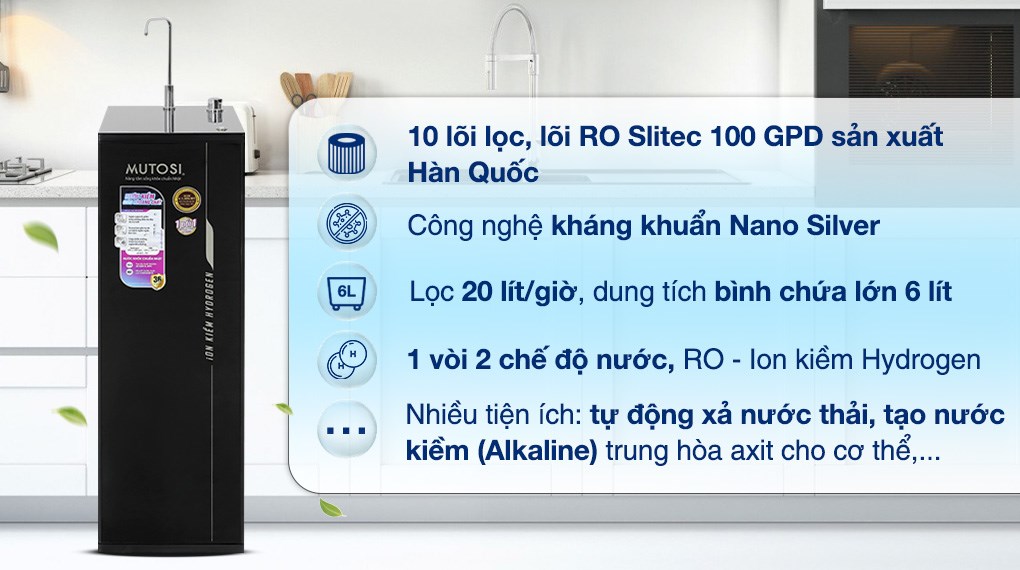
If you are choosing a product that can thoroughly treat hard water at home, please refer to Mutosi's RO water purifier line. With a modern RO membrane filter system that meets NFS international standards, the device ensures the removal of up to 99.99% of dirt, impurities, bacteria and especially mineral ions in water. Users can use pure water, safe for health when the water source after filtration meets the QCVN 6-1: 2010/BYT standards for direct drinking water, certified by Vinacontrol
Above is all the detailed information related to the phenomenon of hard water as well as the most effective way to handle this situation. If you have any questions related to the phenomenon of hard water, please contact Mutosi immediately via hotline 1900 636 595 for advice and answers.
*** Note: The information in the article is for reference only.