


What is hard water? Classification of hard water that you should know
1. Classification based on water hardness level
TDS stands for Total Dissolved Solids, which is an index used to measure the total amount of dissolved solids in a water source. Water with low TDS means pure water with very few minerals. The higher the TDS of a water source, the more dissolved solids there are in the water, meaning the hardness of the water is higher.
Accordingly, based on the TDS index, the USGS (United States Geological Survey) can divide hard water into basic types as shown in the following table:
| Water type | TDS |
| Soft water | 0 - 60 mg/L |
| Moderately hard water | 61 - 120 mg/L |
| Hard water | 121 - 180 mg/L |
| Very hard water | >= 181 mg/L |
2. Classification based on water composition
In addition to the above method, people can also rely on the characteristics of the salt composition in hard water to divide it into 3 types:
2.1 Temporary hard water
Concept
| Temporary hard water is a source of hard water that contains many Ca2+, Mg2+ ions and bicarbonate radicals (HCO3-). Therefore, the main components of temporary hard water will be the two salts Ca(HCO3)2 and Mg(HCO3)2. |
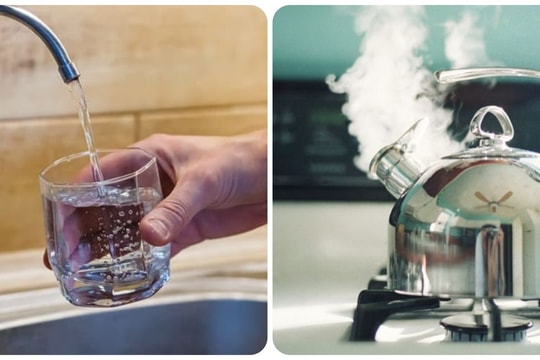
To soften temporary hard water we can apply boiling or thermal distillation methods.
Principle
Because bicarbonate salts are usually unstable, under the effect of heat, they will form a white precipitate at the bottom of the kettle. This white residue is usually carbonate salts of Calcium and Magnesium, completely separate from the remaining water.
How to soften temporary hard water:
- Step 1: First, prepare a small pot or kettle containing the amount of hard water that needs to be treated.
- Step 2: Boil this water for a certain period of time until you see white residue appear at the bottom of the kettle.
- Step 3: Now you just need to filter out the white residue from the water source to get soft water for use.
Although simple and easy to implement, this method has the disadvantage that the quality of the water obtained is not high, and it is easily contaminated after being left for a long time. In addition, because it can only process a small amount of hard water at a time, it is not suitable for families with large usage needs.
2.2 Permanent hard water
Concept
| Permanent hard water is hard water containing high concentrations of anions, such as sulfate anions (SO42-), chloride (Cl-) with salts such as MgCl2, CaCl2, MgSO4, CaSO4. |
The simplest method to soften permanent hard water is to use chemicals.
Principle
Some chemicals such as baking soda (Na2CO3), caustic soda NaOH, barium hydroxide Ba(OH)2, sodium phosphate Na3PO4,... can easily react chemically with mineral components in hard water to form a compound. precipitate. After the reaction occurs, we will filter out the formed precipitate, the resulting water is soft water with high purity, almost no minerals left.
How to soften permanent hard water:
- Step 1: Prepare the appropriate chemicals and the amount of hard water to be treated in a pot or kettle.
- Step 2: Add the chemical to the water and wait a few minutes for the reaction to occur.
- Step 3: When the reaction is complete, filter out the precipitate. The resulting water is now soft water that can be used.
Although this is a relatively effective and easy-to-implement method, some chemicals can be harmful to human health when used for a long time. Therefore, users need to pay attention to buying good quality chemicals and using the appropriate dosage to ensure safety.
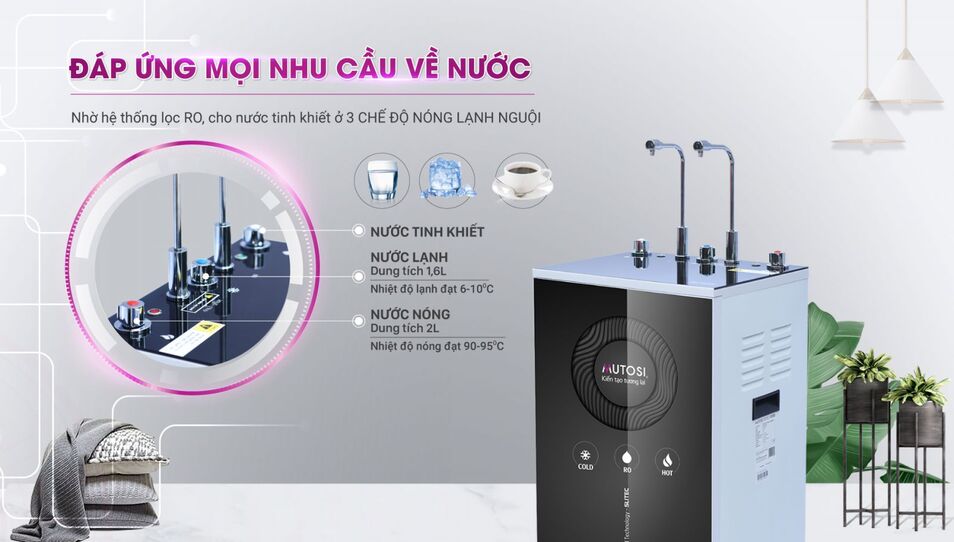
Using purified water from the Mutosi brand water purifier eliminates users' concerns about using water forever! With the operating principle of using high pressure (400 - 1000 psi) created by a booster pump to push water across the RO membrane with a filter pore size of 0.0001 micrometers, creating pure water and 99.99% clean alkaline ionized water.
2.3. Total hard water
Concept
| Hard water is simply understood as hard water that includes both temporary hardness and permanent hardness. Therefore, its components will be the salts Ca(HCO3)2, Mg(HCO3)2, MgCl2, CaCl2, MgSO4, CaSO4. |
Because it is a combination of temporary hard water and permanent hard water, we can apply a combination of the above methods or use ion exchange equipment to soften completely hard water.
Principle
The main component of the above device is ion exchange particles. When hard water flows through, metal ions such as Ca2+, Mg2+ will be removed from the water and replaced by Na+, K+ ions.
How to soften hard water completely
With this method, we only need to install ion exchange equipment for the water source in our home. This product will filter and treat hard water without taking up the user's effort or time.
This method has the advantage of being environmentally friendly and effectively treating hard water. However, the disadvantage is that the cost of implementation is quite high. Therefore, you need to consider your financial situation before installing.
It can be seen that the above methods still have certain limitations. Therefore, to handle the phenomenon of hard water and obtain high quality output water, you should install specialized water filtration equipment, typically water filtration machines of the Mutosi brand.
With the goal of protecting and improving Japanese healthy living standards, Mutosi integrates RO water purifier products with ultra-small filter holes of 0.001 micrometers. Therefore, it has the ability to specifically treat hard water sources to help remove all harmful mineral ions in the water, providing safe output water that meets direct drinking water standards. This is a method that helps to thoroughly treat the phenomenon of hard water with low investment costs, convenient use, and high water quality. Thereby contributing to overcoming all the limitations of other methods. other bring.
Above are some classifications of hard water that you can refer to. If you have any questions related to the phenomenon of hard water, please contact Mutosi immediately via hotline 1900 636 595 for advice and answers.
See more: Integrated hot and cold water purifier
![[REVEALED] Top 7+ Most effective and easiest ways to treat hard water](https://storage.sudospaces.com/sudo-mutosi/uploads/media/phuong-phap-xu-ly-nuoc-cung-1694.jpg)
![[Answer] Does the hot and cold water dispenser filter water?](https://storage.sudospaces.com/sudo-mutosi/uploads/media/picture12.webp)