

Detailed instructions on how to make a water filter tank with sand and gravel 100% successful
1. Technical requirements of water filter tank
- Tank wall size: 2 – 40mm (customized based on system design and water source)
- Shape : Polygon or sphere, minimize corners
- Hardness: Guaranteed to withstand water pressure
- Density: 1400 – 1500 kg/m3
- Impurity content: Removes all impurities that are harmful to health.
- Filtration capacity: Removes dirt, microorganisms, and pollutants in water sources.
Note: The above information is for reference only. To design an effective water filter tank, you should consult with water treatment experts or experienced people. During construction, it is necessary to comply with technical factors to ensure the filter tank operates stably and effectively.
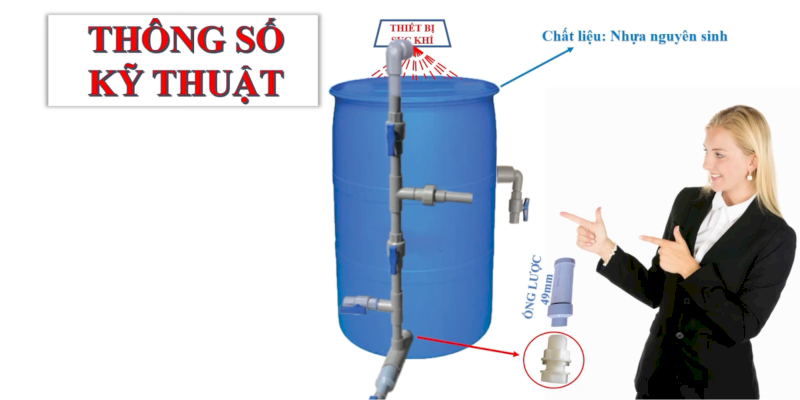
Depending on usage needs, water filter tanks can have different specific technical specifications.
2. Materials to prepare
Filter material
| Material | Uses | Cost (Estimated) |
| Quartz sand | Retains suspended substances that cannot precipitate in water, promoting the water treatment process. | 5,000 VND/kg |
| Golden sand | Helps water become clearer, removes suspended impurities in water | 5,500 VND/kg |
| Black sand | Retains large dirt, removes a small portion of heavy metals such as iron and alum in water | 10,000 VND/kg |
| Quartz gravel | Make a lining material at the bottom of the tank to support other filter materials. | 3,700 VND/kg |
| Manganese Sand | Helps precipitate iron and some toxic substances, remove fishy smell in water | 25,000 VND/kg |
From the above material table, depending on the volume of the filter tank, you can calculate the cost of the necessary materials yourself. For example, for filter tanks with a density of 1,400 to 1,500 kg/m³, the estimated cost will range from 18,000,000 to 20,000,000 VND.
Materials for building filter tanks
| Other materials | Cost (Estimated) |
| Plastic, stainless steel or cement tanks (capacity from 500l - 2,000l) |
|
| Water drain valve | 100,000 - 500,000 VND/valve |
| Water pipe (PVC) | style="text-align:justify; width:52.6167%">20,000 - 50,000 VND/meter|
| Clean water to wash materials before putting them into the filter tank | 50,000 - 200,000 VND |
| Holder, cover |
|
The cost of a water filter tank will depend on the size and type of the specific tank. In particular, a brick tank costs from 300,000 - 700,000 VND, a stainless steel tank costs from 2,500,000 - 8,000,000 VND depending on the volume from 500 liters to 2000 liters .
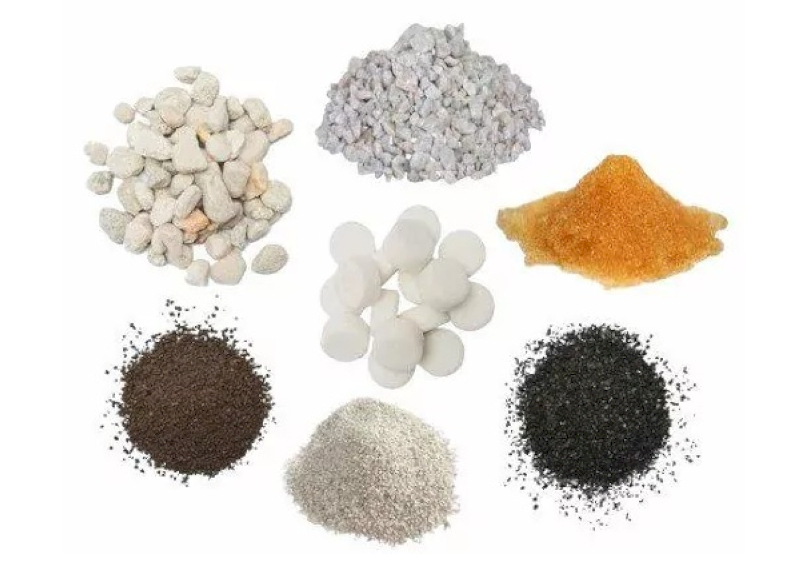
Popular water filter materials made of sand and gravel
3. Detailed instructions on how to make a water filter tank with sand and gravel
Step 1: Prepare the tank and water filter materials
- Choose a location to build the tank: Choose a location to place the filter tank higher than the water usage points to create natural pressure. Then proceed to build the tank according to the technical factors mentioned in section 1.
- Clean the materials:
- Tank: Clean the tank with clean water and a stiff brush to remove dirt and algae from the tank walls.
- Filter material: Rinse all filter materials (sand, gravel, activated carbon...).
- Valve installation:
- Location: Install the bottom drain valve at the lowest position to completely drain the sediment.
- Testing: After installation, recheck the valves for smooth operation.
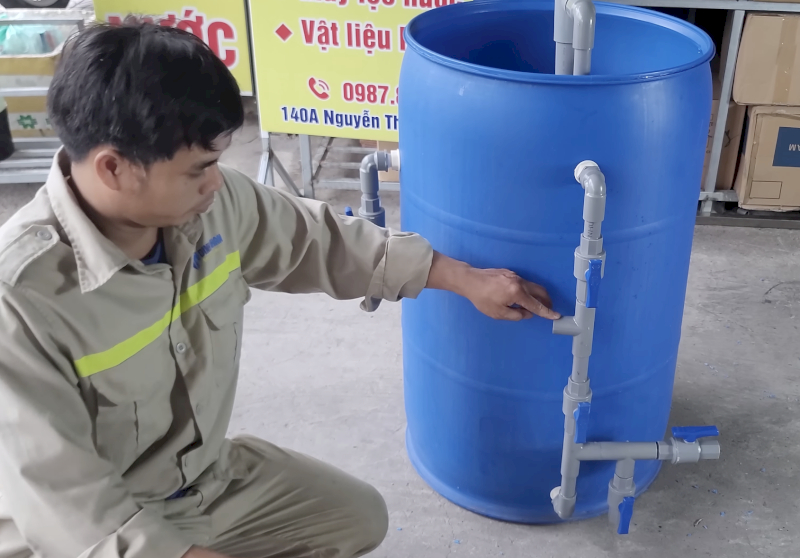
Install valve for filter tank
Step 2: Arrange water filter materials
The water filter tank is made up of 6 types of filter materials arranged in order, each type will be a separate filter layer. The arrangement of the layers from bottom to top is as follows:
- Layer 1: Support layer (Quartz gravel): Large-sized quartz gravel acts as a cushion, protecting the water pipe and evenly distributing pressure on the upper material layers. Layer thickness This is about 10-15cm.
- Layer 2: Coarse filter (Quartz sand): The quartz sand layer removes large dirt particles such as sand and gravel, helping to protect the finer filter layers. The thickness of this layer is about 15cm.
- Layer 3: Iron and manganese removal (Manganese sand): Manganese sand has the ability to oxidize and remove iron and manganese ions dissolved in water, making the water clearer. The thickness of this layer is about 15-30cm.
- Layer 4: Absorption (Activated carbon): Activated carbon has the ability to absorb organic substances, odors, colors, making water taste better. The thickness of this layer is about 20-30cm.
- Layer 5-7: Fine filter (Quartz, yellow sand, black sand): These layers have gradually smaller particle sizes, helping to remove super small dirt particles, making the water clearer and cleaner. Thickness of each layer about 10cm.
Arranging the filter material layers in the above order will help the water pass through the filtration stages. ranging from removing large contaminants to removing the smallest impurities, ensuring the best output water quality.
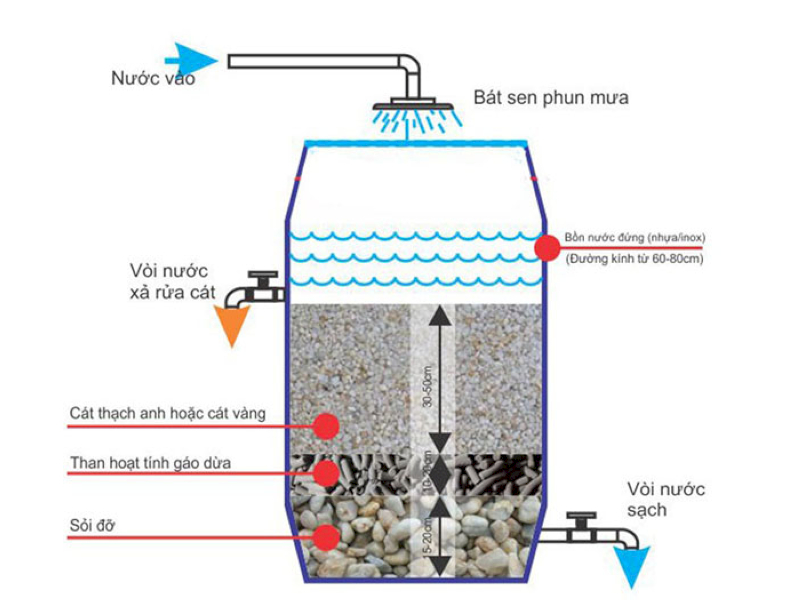
Filter materials need to be divided into separate layers, not mixed.
Step 3: Finalize and test
Once you have completed the arrangement of the filter material layers, you need to take the final steps to complete and put the filter tank into use.
- Piping Installation: Install inlet and outlet pipes to the tank, connect to the water source and point of use.
- Check: Check the entire system again, make sure there are no leaks.
- Test run: Open the valve to let water flow through the tank, observe if the water coming out is clear.
- Flow adjustment: Adjust the water supply valve to achieve the appropriate water flow.
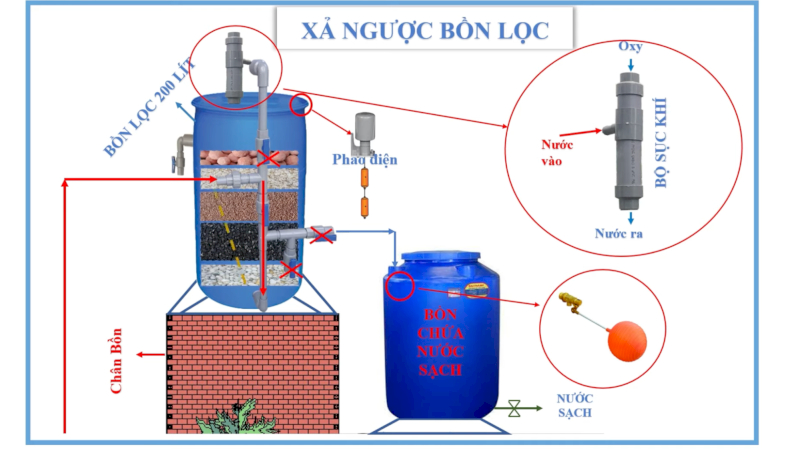
Diagram of homemade sand and gravel water filter tank using 220 liter plastic barrel
Some important notes when making a water filter tank with sand and gravel
- Filter material: Choose clean filter materials without impurities. The particle size of each material must meet the correct standards for the filtration process to be effective. Between the layers of material, non-woven fabric or plastic mesh should be used instead of pineapple sacks for separation and easy replacement.
- Tank structure: The height of the tank should be adjusted so that the material layers occupy about 60-70% of the tank height. Installing additional sprinklers at the top of the tank will help enhance the oxidation process, remove heavy metals and improve water quality.
Instructions for using and cleaning sand and gravel water filter tanks periodically
Process of using water filter tank:
- Pour water to be filtered into the tank : Pour water slowly onto the surface of the filter tank to avoid disturbing the sand and gravel layers.
- Observe the filtration process : Water permeates through the filter layers from top to bottom, this process can take from a few minutes to a few hours depending on the tank size and filtration speed.
- Collect filtered water : Filtered water will flow out through the pipe, you collect it in the container. Note that the first time filtering, you need to check the water quality before using.
Filter tank cleaning
- Periodic cleaning : Every 6 months
- Clean when necessary: Clean immediately when observing signs such as: dirt on the bottom of the tank, algae on the tank wall, and reduced quality of filtered water.
- Cleaning procedure: Clean the filter material layers, paying special attention to the sand and gravel layers. Replace filter materials that have lost their absorption capacity such as activated carbon (if any).
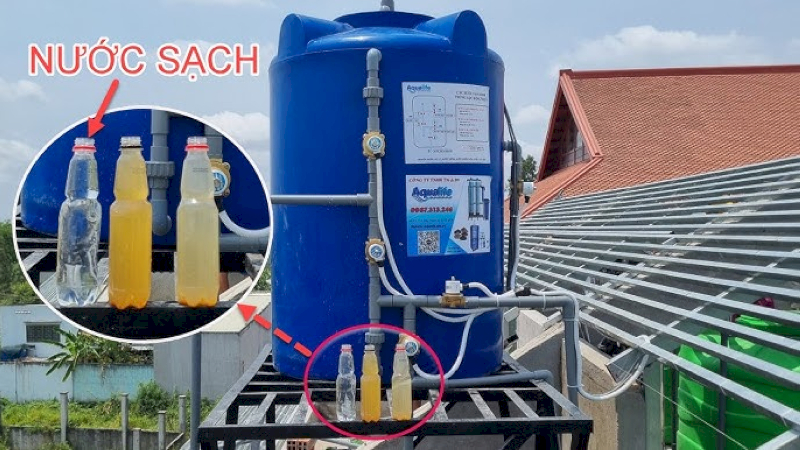
Regularly clean the filter tank to ensure the quality of the output water.
Above are instructions on how to make a simple water filter tank with sand and gravel. The output water can be used for daily activities such as washing, bathing, etc. However, to serve the needs of cooking and drinking directly, you should install an additional RO water purifier to ensure the water source is filtered of bacteria, viruses, and heavy metals.
With the mission of "Improving Japanese-standard health" for millions of Vietnamese people, Mutosi introduces to you a line of water purifiers equipped with Slitec RO membranes that meet NSF/ANSI 58 standards - Global standards for reverse osmosis RO membranes issued by the WHO inspection center. This advanced filtration technology allows the removal of up to 99.99% of bacteria, impurities, metals, ... with sizes from 0.0001 microns. At the same time, the filtration system is also supplemented with functional cores, providing water with a natural sweet taste, rich in minerals, stable pH, ... good for the health of the whole family.
Currently, Mutosi water purifiers are being distributed online and offline at more than 5,000 points of sale nationwide. Customers can visit the store system directly to see genuine products with many accompanying promotions.

You should add a water filter to have a convenient and safe source of direct water.
The above article has introduced you to how to make a sand and gravel water filter tank in detail. Just prepare all the materials, follow the instructions and clean regularly, you can completely own a clean, safe water source for your family. Let's start doing it today to protect the health of your whole family!
If you have any questions, please contact Mutosi hotline 1900 636 595 for further advice and answers.